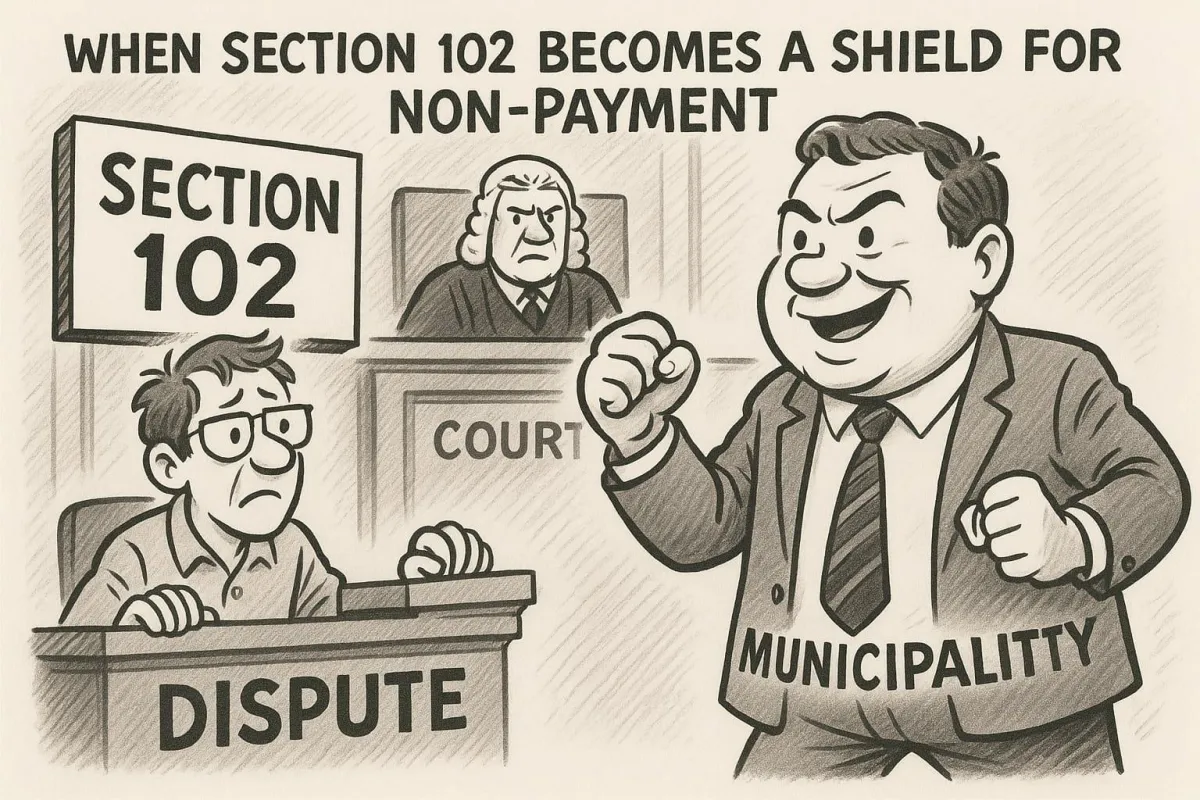
When Section 102 of the Municipal Systems Act Becomes a Shield for Non-Payment in South Africa
When Section 102 of the Municipal Systems Act Becomes a Shield for Non-Payment in South Africa
Introduction: The Growing Challenge in Municipal Revenue Enforcement
Across South African municipalities, Section 102 of the Municipal Systems Act is increasingly becoming a contested area in financial governance and credit control enforcement. While the provision was designed to improve administrative efficiency in municipal billing systems, its practical application has revealed unintended consequences—particularly where it is used as a mechanism to delay or avoid payment obligations.
Municipal revenue management is already under pressure due to rising service delivery costs, ageing infrastructure, and constrained fiscal resources. When legal provisions such as Section 102 are misapplied or strategically used to suspend payment obligations, the result is a weakening of the entire municipal financial ecosystem.
This publication explores the purpose of Section 102, its correct application, and the financial governance risks that arise when it is used as a shield for non-payment.
Understanding Section 102 of the Municipal Systems Act
Section 102 of the Municipal Systems Act (Act 32 of 2000) allows municipalities to implement administrative measures such as:
Consolidation of multiple municipal accounts linked to a single consumer
Allocation of payments across different municipal services
Correction of billing discrepancies and account alignment
Administrative resolution of legitimate billing disputes
The intention of this provision is to improve billing accuracy, ensure administrative efficiency, and support fair resolution of genuine disputes between municipalities and consumers.
However, the provision was never intended to be used as a tool to suspend or indefinitely delay payment obligations.
The Misuse of Section 102 as a Payment Delay Mechanism
In practice, many municipalities and financial practitioners have observed a growing trend where Section 102 is invoked in a manner that extends beyond its intended scope.
This includes situations where:
Consumers raise broad or non-specific disputes without supporting documentation
Payments are withheld indefinitely pending “investigation”
Accounts remain unpaid while disputes are unresolved for extended periods
Credit control processes are paused without legal justification
Municipal revenue systems absorb prolonged arrears due to administrative delays
In these cases, Section 102 effectively becomes a procedural shield that interrupts normal credit control enforcement.
This misuse is particularly problematic when disputes are not substantiated but are used as a strategy to delay disconnection, enforcement action, or debt recovery.
Impact on Municipal Revenue Collection and Financial Stability
The financial implications of improper Section 102 application are significant and far-reaching.
1. Decline in Revenue Collection Rates
Municipalities experience reduced cash inflows as unpaid accounts accumulate under disputed status.
2. Increased Debtor Books
Outstanding balances grow, weakening the municipality’s balance sheet and financial position.
3. Cash Flow Constraints
Delayed payments affect operational liquidity, limiting the municipality’s ability to fund service delivery.
4. Service Delivery Disruptions
Reduced revenue impacts essential services such as water supply, electricity maintenance, sanitation, and infrastructure development.
5. Weakening of Credit Control Systems
When enforcement is inconsistently applied, payment discipline across the municipality deteriorates.
Why Municipalities Struggle to Enforce Credit Control Effectively
Several structural and operational challenges contribute to weak enforcement:
Political sensitivity around service disconnections
Administrative backlog in dispute resolution processes
Lack of clear standard operating procedures for Section 102 cases
Limited legal escalation capacity for unresolved disputes
Fear of litigation even in cases with weak or unsupported claims
Inconsistent application of credit control policies across departments
These challenges create an environment where non-payment can persist without timely resolution.
Distinguishing Genuine Disputes from Tactical Non-Payment
A critical governance requirement is the ability to differentiate between legitimate billing disputes and strategic non-payment behaviour.
Genuine disputes typically involve:
Verified billing errors
Meter reading inconsistencies
Service delivery discrepancies
Documented account anomalies
Tactical disputes often involve:
Repeated objections without new evidence
Broad claims without specificity
Extended delays in providing supporting documentation
Use of disputes primarily to avoid disconnection or enforcement
Without clear classification frameworks, municipalities risk treating all disputes equally, weakening enforcement mechanisms.
Governance and Financial Risk Implications
From a governance perspective, the misuse of Section 102 introduces systemic risks:
Weak internal control environments
Reduced accountability in revenue management
Increased audit findings related to debtors and revenue recognition
Poor financial reporting accuracy under GRAP standards
Elevated risk of financial distress in lower-capacity municipalities
Financial governance frameworks depend on consistency, transparency, and enforceable processes. When exceptions become routine, the system loses integrity.
Strengthening Municipal Credit Control and Enforcement Systems
To address these challenges, municipalities should consider the following corrective measures:
1. Formalise Section 102 Dispute Frameworks
Clear criteria must define what qualifies as a valid dispute and what does not.
2. Maintain Credit Control During Dispute Resolution
Unless legally restricted, credit control actions should continue during dispute processes.
3. Implement Escalation Protocols
Unsupported disputes should be escalated to legal or senior financial management for resolution.
4. Improve Billing Accuracy and Metering Systems
Many disputes originate from preventable system errors and outdated infrastructure.
5. Strengthen Revenue Governance Oversight
Regular monitoring of disputed accounts should be part of financial reporting processes.
The Importance of Enforcement in Sustainable Governance
Effective municipal governance requires a balance between fairness and financial discipline. Enforcement of payment obligations is not punitive—it is essential for sustainability.
Without consistent enforcement:
Payment culture deteriorates
Municipalities become increasingly dependent on external support
Service delivery performance declines
Financial credibility is weakened
Strong governance frameworks ensure that legal provisions are applied correctly, consistently, and in alignment with their intended purpose.
Conclusion
Section 102 of the Municipal Systems Act remains an important administrative tool for managing billing and account-related disputes. However, its misuse as a mechanism for delaying payment presents a serious risk to municipal financial stability and governance integrity.
Municipalities that fail to enforce clear credit control policies risk long-term financial instability, while those that implement structured dispute resolution frameworks strengthen both revenue collection and service delivery outcomes.
Sustainable municipal finance depends on discipline, consistency, and the correct application of legislative frameworks.
Contact Information
For professional assistance with municipal finance governance, credit control systems, or compliance advisory services:
📞 Phone: 076 999 1020
🌐 Website: https://tladvisory.co.za/